


I remember that 10 years ago Dieter Zetsche, the CEO of Daimler Benz, said he feared competition from the likes of Apple and Google rather than traditional rivals Audi or BMW. At the time, it seemed fanciful, if not delusional. But it was prescient.
Zetsche’s comments recognized a broader shift in the technological landscape that has the potential to disrupt even the most stable “physical” companies. My question is… Will the same happen to gold?
In 2002, the gold market saw its most epic transformation when it shifted its focus from jewelry promotion and invested in a new product called an ETF. By creating a new channel between the institutional investment community and direct access to the gold market, it was a major factor contributing to a decade of double-digit increases in gold prices, with prices rising from $280 to $1,670. Arguably, while impressive, it still missed the “mother lode” by not making gold universally available and fungible for ALL investors.
We have always known that bitcoin was modeled on the form and structure of the gold market and that there was strong DNA between the assets. We also hypothesized that the two markets might share the growing desire or need for an independent, digital form of money as trust in fiat currencies declined. The professional gold market has been slow to embrace powerful technology despite efficiency gains, perhaps due to reputational concerns (early on, the crypto space was a bit lax in terms of AML and KYC). And the modest uptake of gold-backed tokens marketed by independents seems to validate this decision. In 2023, the total amount of gold accumulated in tokens was less than 1% of one year’s gold demand. It didn’t even deserve a footnote. Move along… Nothing to see here.
But Zetsche’s observations remain. Perhaps the slow adoption of the fusion between technology and our very traditional market was just a matter of timing.
I rarely comment on specific companies (or people)… it’s not my place… But today you will see several references to the recent rapid adoption of gold-backed real-world assets. Specifically Tether, PaxGold, and Matrixport (my apologies to others not named).
What caught my attention was the fact that Tether has linked up with Cantor Fitzgerald—rather than traditional bullion players—with a $1.1 billion financing initiative. It is the kind of left-field move that could signal a seismic shift. Two things stand out… the scale of the investment… and the credibility and distribution that Cantor brings to the deal as a mid-sized investment bank with a global footprint. If Tether significantly expands the issuance of XAUT with Cantor as the broker and its broad distribution and liquidity channels, then this could become self-sustaining. It will also be interesting to see how market leader Paxos responds with its PAXG token.
It is primarily about adoption, trust, and transparency.
Surely there will always be many questions when a traditional financial firm links up with an offshore stablecoin issuer, but this is probably worth keeping an eye on. My feeling is that the timing is quite good.
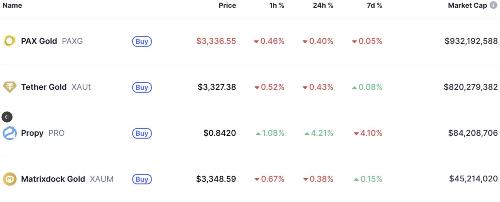
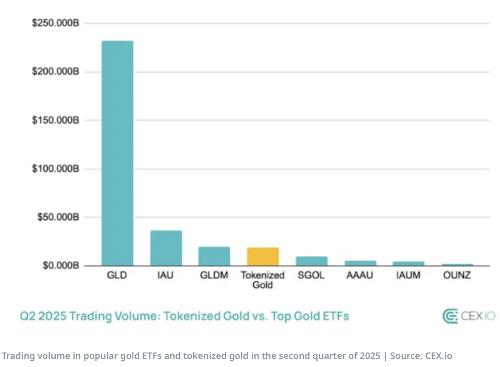
As the image below shows, tokenized gold is still very modest compared to major gold ETFs in terms of AUM, but in the second quarter of 2025, it is outperforming ETFs in growth, rising from $2.4 billion to $19.2 billion according to CEX.IO—an eightfold increase—driven by retail demand, the “mother lode.” Reportedly, PAXG also saw a significant 25% increase during the period.
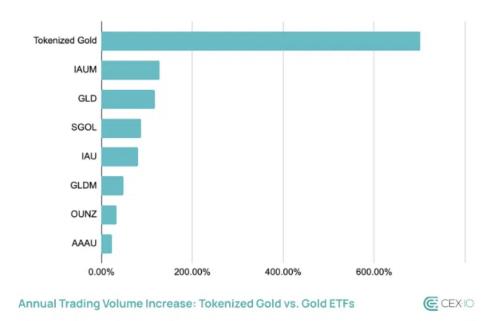
In the short term, this is unlikely to have a dramatic impact on gold prices, but we thought that back in 2002 as well. Turning gold into a digital asset does not change its nature, but its accessibility.