


- Central banks worldwide are likely accumulating gold as a strategy to diversify away from the dollar, in light of concerns over persistent U.S. fiscal deficits and inflationary pressures.
- Despite the stability of the dollar and rising real yields, gold prices have climbed to 50-year highs against most major currencies, driven not by ETFs or seasonal purchases, but by central bank buying.
- The increase in gold reserves by central banks, particularly in China, Germany, and Turkey, underscores a broader trend toward safeguarding reserve assets from potential dollar devaluation and financial system risks.
Written by Simon White, Bloomberg macro strategist,
Powell may not be overly concerned about inflation, with his recent comments reiterating that the Federal Reserve is on track to cut rates this year, but other central banks are not as relaxed. Gold’s new high signals that global central banks are likely hoarding the precious metal in an effort to diversify away from the dollar, as persistently large fiscal deficits threaten to further erode its real value and lead to higher inflation.
Gold’s move in recent days has been broad and pronounced (as well as suggested by low gold volume), with the precious metal reaching 50-year highs against three-quarters of major developed and emerging market currencies. The largest gold holdings after jewelry are for private investment—ETFs, bars, and coins—followed by official central bank reserves.
In recent years, the swing buyers have been ETFs, which hold approximately 2,500 tons of gold. But ETF holdings have decreased even as the dollar price of gold has risen.
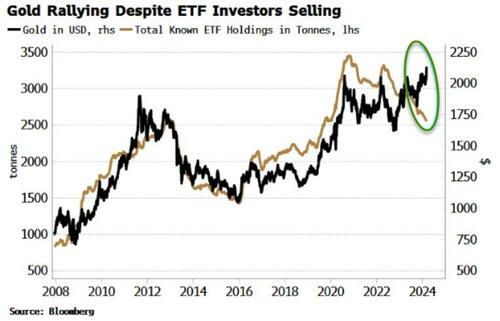
The dollar has remained stable and real yields (which nonetheless have a non-linear relationship with gold) are higher over the last three months. Most seasonal buying, such as Diwali in India, is likely behind us. Furthermore, silver has not participated in the rally. It is therefore reasonable to assume that the official sector, namely central banks, has been a significant factor in gold’s recent ascent to new highs.
In the period leading up to the pandemic, and again in the aftermath of the Russian invasion of Ukraine, global central banks continued to increase their gold reserves even as ETF investors (perhaps dazzled by the bright lights of cryptocurrencies) reduced theirs.

Over the last six months, China, Germany, and Turkey have increased their gold reserves the most (these are official holdings—when it comes to China, its true holdings are likely much higher than declared).
Central banks want gold because it is a hard asset; it is not part of the financialized system when owned outright. But the dominant reason is the desire to diversify away from the dollar. If you are not on friendly terms with the United States, then it is a way to prevent your reserve assets from being seized, as happened to Russia.
But central banks around the world are most likely uncomfortable holding too many dollars when the United States is running large fiscal deficits that cause inflation. The dollar is structurally overvalued on a purchasing power parity basis against major developed market currencies. As the chart below shows, this indicates an underperformance of the dollar in the coming years.
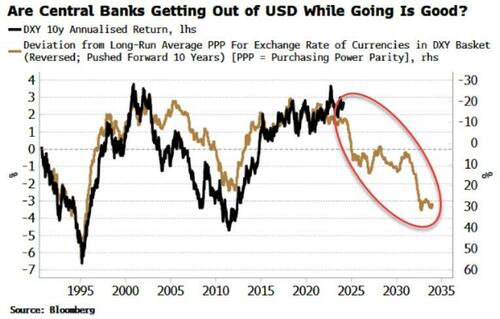
Gold ETF investors may not see much risk from inflation and the dollar, but central bankers are signaling otherwise.
By Zerohedge.com